Excited to release initial insights for our Survey on Production MLOps!! The survey would still benefit from your contribution and it's OPEN FOR RESPONSES 🚀🚀🚀
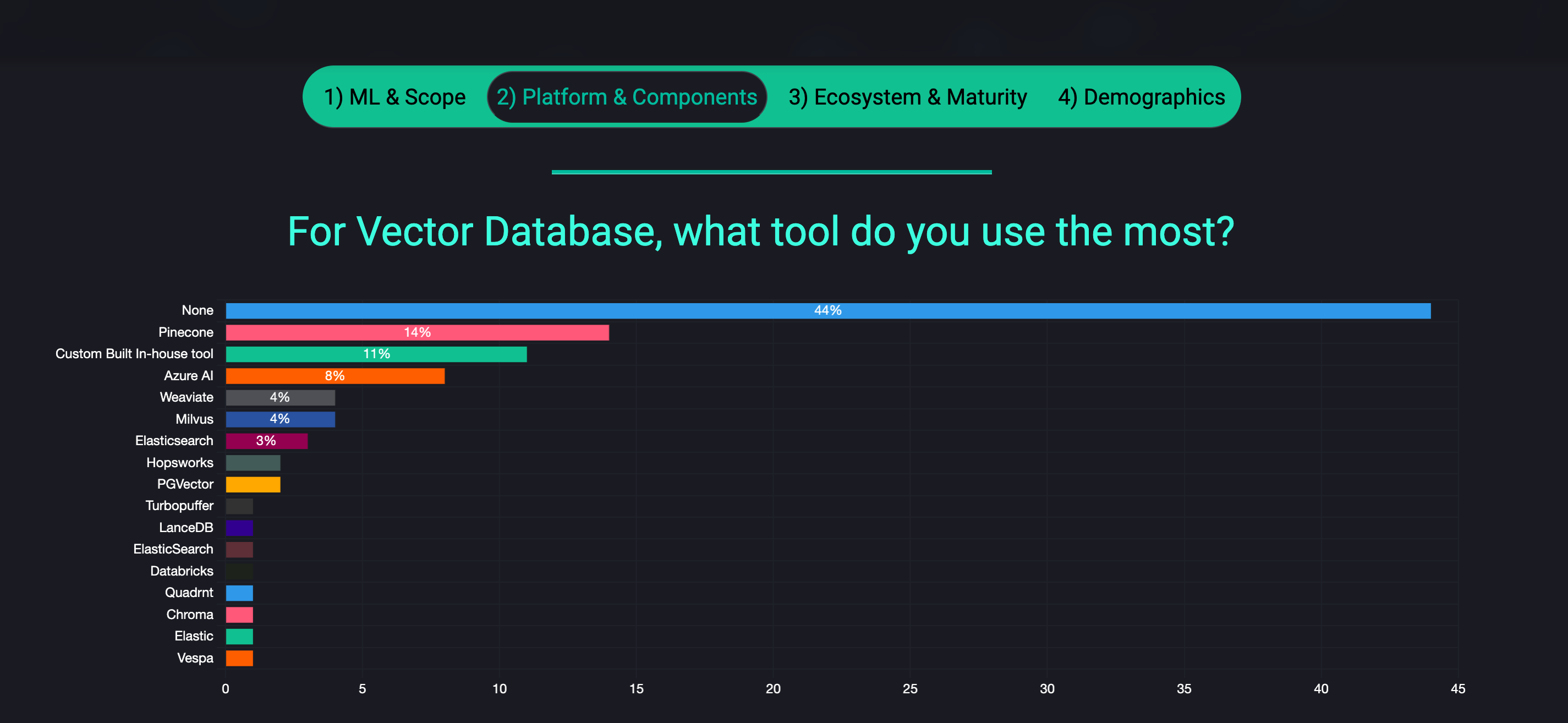
Vector Databases are still skyrocketing: About 56% of orgs reported using vector databases, with 14% using PineconeDB (+9% YoY), about 11% have custom built in-house tools, and 8% use Azure AI (cosmos/search) surprisingly! There is still lack of consolidation, with the following contenders being Weaviate and Milvus with 4% and Elasticsearch with 3%.
If you have a few minutes, your contribution will make a significant difference to the whole production ML ecosystem 🥳 The results will be shared as open source like last year!! You can add your response directly at:
https://forms.gle/KF16EckuxNUKDtDK8 🔥
Thank you for being part of over 70,000+ ML professionals and enthusiasts who receive weekly articles & tutorials on Machine Learning & MLOps 🤖 You can join the newsletter https://bit.ly/state-of-ml-2025 ⭐
If you like the content please support the newsletter by sharing with your friends via ✉️ Email, 🐦 Twitter, 💼 Linkedin and 📕 Facebook!
This week in ML Engineering:
- Stanford CS236: Deep Generative Models
- Introducing the OWASP Top 10 2025
- The State of MLOps 2025 Survey 🔥
- GenAI World Foundation Models
- Synthetic Time Series Foundation Models
- Open Source ML Frameworks
- Awesome AI Guidelines to check out this week
- + more 🚀
Stanford CS236: Deep Generative Models
Stanford CS236 is one of the best in-depth courses on Generative Deep Learning (LLMs, TTS, VAEs, GANs, etc) and provides a super comprehensive deep dive into the key foundational concepts that are now becoming the backbone of modern AI products. If you are interested on brushing up on fundamentals, this is a great and rigorous course that covers these foundational models as probabilistic data simulators. It focuses on how to parameterize complex distributions with deep nets, how different training criteria trade off sample quality, likelihood, and stability, and how to do efficient sampling and inference for tasks like conditional generation, editing, super-resolution, inpainting, control, and inverse problems. There are only growing applications for these models across images, text, audio, video, robotics, medical imaging, and many more domains so definitely recommended to check it out.
Introducing the OWASP Top 10 2025
The OWASP Foundation has now released the Top 10 Vulnerabilities for 2025! The vulnerabilities that made the 2025 list are: 1. Broken Access Control, 2. Security Misconfiguration, 3. Software Supply Chain Failures, 4. Cryptographic Failures, 5. Injection, 6. Insecure Design, 7. Authentication Failures, 8. Software or Data Integrity Failures, 9. Logging & Alerting Failures, 10. Mishandling of Exceptional Conditions. Although this is focused for application security, these are also critical in production machine learning systems! Also worth checking out the OWASP ML Top 10, and the OWASP GenAI Top 10 - as well as various reports that have been released as part of the Agentic Security [link] (disclaimer: I am part of the reviewer board).
The State of MLOps 2025 Survey 🔥
We are excited to release initial insights for our Survey on Production MLOps!! Vector Databases are still skyrocketing: About 56% of orgs reported using vector databases, with 14% using PineconeDB (+9% YoY), about 11% have custom built in-house tools, and 8% use Azure AI (cosmos/search) surprisingly! There is still lack of consolidation, with the following contenders being Weaviate and Milvus with 4% and Elasticsearch with 3%. We still need your support to continue collecting diverse perspectives to map the ecosystem! Please help us with your response, as well as by sharing with your colleagues 🚀🚀🚀 If you have a few minutes, your contribution will make a significant difference to the whole production ML ecosystem 🥳 The results will be shared as open source like last year!! You can add your response directly at: https://forms.gle/KF16EckuxNUKDtDK8🔥
GenAI World Foundation Models
What happens when you train a model using keyboard inputs to predict images of environments? You end up with interactive 3D AI worlds! The "Marble" model / architecture seems to take it to the next level: Marble is a generative multimodal 3D world model that is able to model text, images, multi-view video/images into full 3D environments, and then lets you iteratively refine them via AI-native editing, spatial expansion, and composition of multiple scenes. Recently we had seen attempts of simulating games, and even OS environments (incl. the impressive simulation of NeuralOS), however this seems to take it to the next level by enabling the creation of worlds from prompts which is impressive. One of the most interesting breakthroughs is the ability to export to triangle meshes and camera-controlled videos which seems would be on the path of making it usable in game engines, VFX, simulators, and robotics workflows. This is definitely an exciting space, and coincidentally seems to be the same domain which Yann LeCunn will be exploring after leaving META this week!
Synthetic Time Series Foundation Models
Time-series forecasting quietly runs the modern world, and the race for Forecasting Foundation MOdels is growing! This month we saw a new contender with a new approach, with TempoPFN tackling univariate zero-shot forecasting built on a linear RNN backbone with purely synthetic data! On the paper it seems to have promising performace, however only against other models trained with synthetic data, so it would be great to also see how it fairs against some of the current heavyhitters (aka Chronos, TimeGPT, etc). It is certainly an exciting time for this space - definitely worth keeping an eye as we likely will see many more releases in the year to come!
Upcoming MLOps Events
The MLOps ecosystem continues to grow at break-neck speeds, making it ever harder for us as practitioners to stay up to date with relevant developments. A fantsatic way to keep on-top of relevant resources is through the great community and events that the MLOps and Production ML ecosystem offers. This is the reason why we have started curating a list of upcoming events in the space, which are outlined below.
You can also find our upcoming events and past talk recordings on the talks and events page.
Upcoming conferences where we're speaking:
- WeAreDevelopers 2025 - 9th July @ Berlin
- SRE Con EMEA 2025 - 7th Oct @ Dublin
- World Summit AI Europe - 08 Oct @ Amsterdam
- Code.Talks 2025 - 5th Nov @ Hamburg
Other upcoming MLOps conferences in 2025:
- ODSC East - May 13 @ Boston
- Data & AI Summit - 9th June @ San Francisco
- AI Summit London - 12th June @ UK
- MLOps World - Oct 8-9 @ Austin
In case you missed our talks:
- The State of AI in 2025 - WeAreDevelopers 2025
- Prod Generative AI in 2024 - KubeCon AI Day 2025
- The State of AI in 2024 - WeAreDevelopers 2024
- Responsible AI Workshop Keynote - NeurIPS 2021
- Practical Guide to ML Explainability - PyCon London
- ML Monitoring: Outliers, Drift, XAI - PyCon Keynote
- Metadata for E2E MLOps - Kubecon NA 2022
- ML Performance Evaluation at Scale - KubeCon Eur 2021
- Industry Strength LLMs - PyData Global 2022
- ML Security Workshop Keynote - NeurIPS 2022
Open Source MLOps Tools
Check out the fast-growing ecosystem of production ML tools & frameworks at the github repository which has reached over 10,000 ⭐ github stars. We are currently looking for more libraries to add - if you know of any that are not listed, please let us know or feel free to add a PR. Four featured libraries in the GPU acceleration space are outlined below.
- Kompute - Blazing fast, lightweight and mobile phone-enabled GPU compute framework optimized for advanced data processing usecases.
- CuPy - An implementation of NumPy-compatible multi-dimensional array on CUDA. CuPy consists of the core multi-dimensional array class, cupy.ndarray, and many functions on it.
- Jax - Composable transformations of Python+NumPy programs: differentiate, vectorize, JIT to GPU/TPU, and more
- CuDF - Built based on the Apache Arrow columnar memory format, cuDF is a GPU DataFrame library for loading, joining, aggregating, filtering, and otherwise manipulating data.
If you know of any open source and open community events that are not listed do give us a heads up so we can add them!
OSS: Policy & Guidelines
As AI systems become more prevalent in society, we face bigger and tougher societal challenges. We have seen a large number of resources that aim to takle these challenges in the form of AI Guidelines, Principles, Ethics Frameworks, etc, however there are so many resources it is hard to navigate. Because of this we started an Open Source initiative that aims to map the ecosystem to make it simpler to navigate. You can find multiple principles in the repo - some examples include the following:
- MLSecOps Top 10 Vulnerabilities - This is an initiative that aims to further the field of machine learning security by identifying the top 10 most common vulnerabiliites in the machine learning lifecycle as well as best practices.
- AI & Machine Learning 8 principles for Responsible ML - The Institute for Ethical AI & Machine Learning has put together 8 principles for responsible machine learning that are to be adopted by individuals and delivery teams designing, building and operating machine learning systems.
- An Evaluation of Guidelines - The Ethics of Ethics; A research paper that analyses multiple Ethics principles.
- ACM's Code of Ethics and Professional Conduct - This is the code of ethics that has been put together in 1992 by the Association for Computer Machinery and updated in 2018.
If you know of any guidelines that are not in the "Awesome AI Guidelines" list, please do give us a heads up or feel free to add a pull request!
About us
The Institute for Ethical AI & Machine Learning is a European research centre that carries out world-class research into responsible machine learning.